

Saturday, November 20, 2010


The Kongamato

Though there have been various, specific names given to the strange flying reptiles reported around the world, the term "Kongamato" will be used during this analysis for simplicity's sake.
Sightings of the Kongamato come primarily from the continent of Africa, as do the reports of most other land cryptids. From Zambia to Kenya, Zimbabwe to New Guinea, the Kongamato is increasingly becoming a creature of reality, and no longer myth.
In 1925, a distinguished English newspaper correspondent, G. Ward Price, along with the future Duke of Windsor, took an official visit to Rhodesia. While there, they reported a story that a civil servant told them of the wounding of a man who entered a feared swamp in Rhodesia; a place known to be an abode of "demons." According to the story, the brave native entered the swamp, determined to explore it in spite of the dangers. When returning, they found him on the verge of death. With a great wound in his chest, the native recounted how a strange, huge "bird" with a long beak attacked him. The civil servant, wanting to identify the creature, showed the man a picture of a Pterosaur from a book of prehistoric animals. When observing the drawing, the man screamed in terror, fleeing from the servant's home.
Reports such as this fascinate some, and bore others. Unfortunately, photographic evidence of Kongamatos scarcely exist, leading many to scoff at the idea.
One interesting aspect of the Kongamato is its reported ability to glow at night. Though not an actual "ability," but more of a natural phenomenon pertaining to bioluminescence, the Kongamato continues to grow as a fascinating creature unlike anything else.

A college student from Kenya, surprised over the fact that Americans believed Pterosaurs to have existed millions of years ago, told Dr. Kent Hovind over the phone one evening of the flying reptiles of his native land. In detail, he explained to Mr. Hovind their natural habits. They consider them pests, similar to buzzards. A common problem they have, explained the student, is making sure to bury their dead deep enough. Interestingly, the Kongamatos will unearth buried natives and feed upon their dead flesh.
Reports of prehistoric flying creatures are not just limited to dense swampy regions, however. There are also reports of giant flying lizards from the deserts of Namibia. In 1988, Professor Roy Mackal led an expedition to Namibia where reports of a creature with a wingspan of up to 30 ft were collected. According to eye witnesses, the avian cryptid usually glided through the air, but also was capable of true flight. It was usually seen at dusk, gliding between crevices between two hills about a mile apart. Although the expedition was unsuccessful in collecting solid evidence, one team member, James Kosi, reportedly saw the creature from about 1000 ft. away. He described it as a giant glider shape, black with white markings.
" . . .And I looked. Then I let out a shout also and instantly bobbed down under the water, because, coming straight at me only a few feet above the water was a black thing the size of an eagle. I had only a glimpse of its face, yet that was quite sufficient, for its lower jaw hung open and bore a semicircle of pointed white teeth set about their own width apart from each other. When I emerged, it was gone. George was facing the other way blazing off his second barrel. I arrived dripping on my rock and we looked at each other.
'Will it come back?' we chorused. And just before it became too dark to see, it came again, hurtling back down the river, its teeth chattering, the air 'shss-shssing' as it was cleft by the great, black, dracula-like wings. We were both off-guard, my gun was unloaded, and the brute made straight for George. He ducked. The animal soared over him and was at once swallowed up in the night."
Ivan T. Sanderson, 1932
Zoologist, Writer
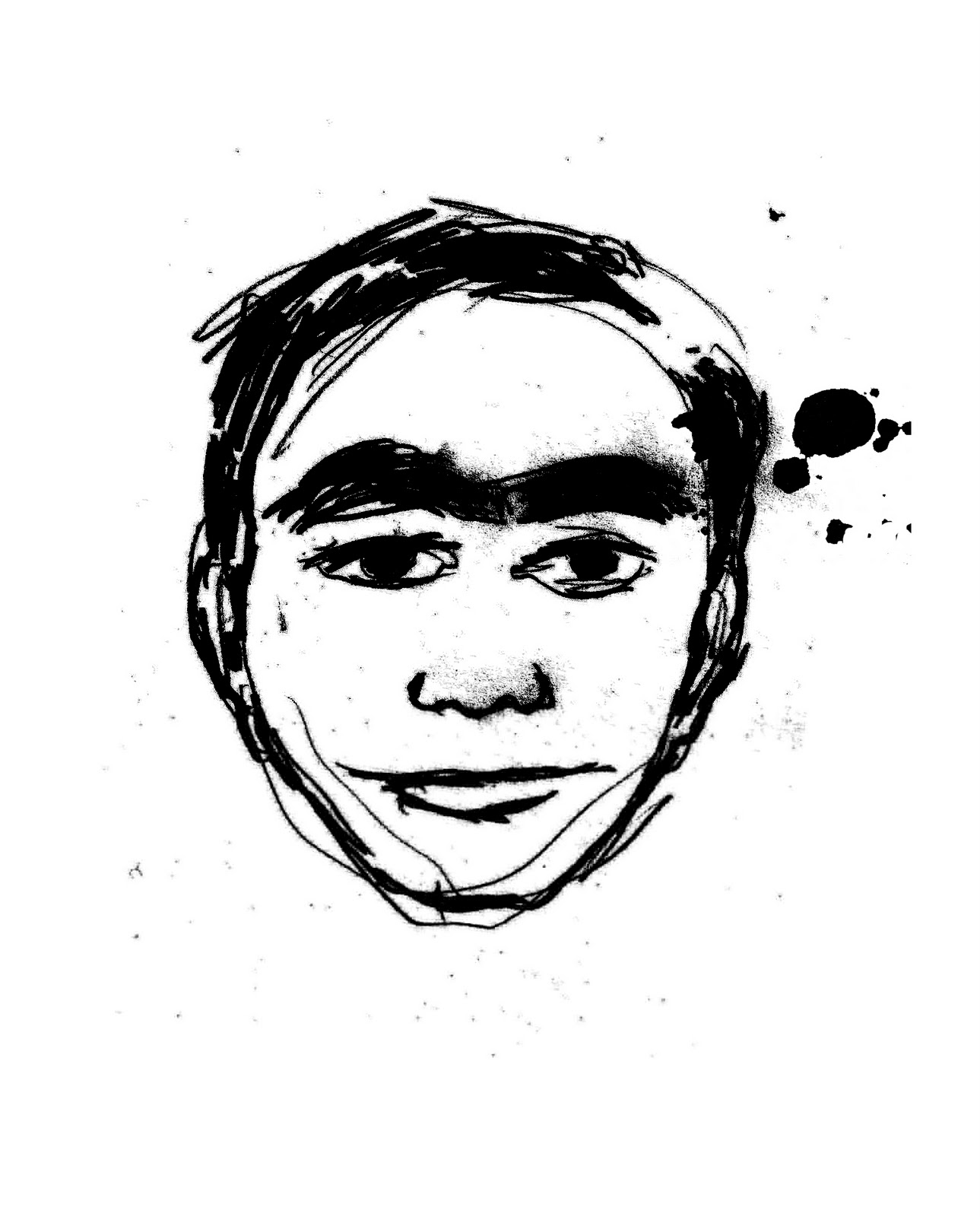
Ever Dream of This Man?

That portrait lies forgotten on the psychiatrist’s desk for a few days until one day another patient recognizes that face and says that the man has often visited him in his dreams. He also claims he has never seen that man in his waking life.
The psychiatrist decides to send the portrait to some of his colleagues that have patients with recurrent dreams. Within a few months, four patients recognize the man as a frequent presence in their own dreams. All the patients refer to him as THIS MAN.
From January 2006 until today, at least 2000 people have claimed they have seen this man in their dreams, in many cities all over the world: Los Angeles, Berlin, Sao Paulo, Tehran, Beijing, Rome, Barcelona, Stockholm, Paris, New Dehli, Moscow etc.
At the moment there is no ascertained relation or common trait among the people that have dreamed of seeing this man. Moreover, no living man has ever been recognized as resembling the man of the portrait by the people who have seen this man in their dreams.
THEORIES
Several theories have been developed to explain the mysteriously recurring presence of this man in the dreams of different people who are not related in any way. The following theories are the ones that elicit the greatest interest among the dreamers themselves.
ARCHETYPE THEORY
According to Jung's psychoanalytic theory, this man is an archetypal image belonging to the collective unconscious that can surface in times of hardship (emotional development, dramatic changes in our lives, stressful circumstances etc.) in particularly sensitive subjects.
RELIGIOUS THEORY
According to this theory this man is the image of the Creator, that is to say one of the forms in which God manifests himself today. This is the reason why his indications and the words he utters during the dreams should be decidedly followed by the dreamers.
DREAM SURFER THEORY
It is the most interesting theory and the one that has the greatest implications, but it has also the lowest scientific credibility. According to this theory this man is a real person, who can enter people's dreams by means of specific psychological skills. Some believe that in real life this man looks like the man in the dreams. Others think that the man in the dreams looks completely different from his real life counterpart. Some people seem to believe that behind this man there is a mental conditioning plan developed by a major corporation.
DREAM IMITATION THEORY
This is a scientific psycho-sociological theory which claims that this phenomenon has arisen casually and has progressively developed by imitation. Basically when people are exposed to this phenomenon they become so deeply impressed that they start seeing this man in their dreams.
DAYTIME RECOGNITION THEORY
This theory states that the apparitions of this man are purely casual. Normally we do not remember precisely the faces we see in our dreams. The image of this man would thus be an instrument which, in the subject's waking life, facilitates recognition of an undefined oneirical image.




Thursday, October 28, 2010
Time Traveler? Video Shows What Appears To Be A Woman Talking On Cell Phone In 1928
The internets has been buzzing in the last couple of days about video footage that appears to show a woman talking on a cellphone… in 1928.
The footage is from the premiere of Charlie Chaplin’s film "The Circus" and was spotted by Belfast filmmaker George Clarke.
It shows a woman walking by the camera, talking with her hand to her ear, seemingly holding something to it.
What do you think?


Saturday, July 24, 2010
Strange creature ripping apart cattle in a small village of Ecuador


The small community of “La Cuadra” (The block) has seen multiple cattle mutilated and torn apart by something powerful. The ghastly findings are out of the ordinary, even for local known predators. The residents concluded that what ever it is that has killed steer and cows, it’s powerful enough to rip them apart and leave huge, deep prints with large claws in the mud.
Arming themselves with machetes, guns and flashlights a search party was rounded up in order to capture the creature. Upon investigation the residents saw a ‘large black animal move through brushes”. Nearby they found some cattle remains. What are the residents of La Cuadra dealing with?
Talks from the residents point to a possible escaped cougar. Others say that this is just another attack by the infamous Chupacabra.
No photographs of the paw prints have been released, although photographs of the mutilated cattle speak for the shocking attacks. What is stalking the cattle in Ecuador? In order to inflict that kind of damage seen in the photographs, I would have to say that a large cat is on the lose, or a pack of canids are attacking the cattle.
Subscribe to:
Posts (Atom)


