Your Ad Here

Friday, December 23, 2011

'Space ball' drops on Namibia


A large metallic ball has fallen out of the sky on a remote grassland in Namibia, prompting baffled authorities to contact NASA and the European space agency.

The hollow ball with a circumference of 1.1 metres was found near a village in the north of the country some 750km from the capital, Windhoek, according to police forensics director Paul Ludik.

Locals had heard several small explosions a few days beforehand, he said. Advertisement: Story continues below With a diameter of 35cm, the ball has a rough surface and appears to consist of "two halves welded together". It was made of a "metal alloy known to man" and weighed six kilograms, said Ludik. It was found 18 metres from its landing spot, a hole 33 centimetres deep and 3.8 metres wide.

Several such balls have dropped in southern Africa, Australia and Latin America in the past 20 years, authorities found in an internet search. The sphere was discovered mid-November, but authorities first did tests before announcing the find. Police deputy inspector-general Vilho Hifindaka concluded the sphere did not pose any danger. "It is not an explosive device, but rather hollow, but we had to investigate all this first," he said. 

Saturday, December 10, 2011

Woolly Mammoth to be cloned


Within five years, a woolly mammoth will likely be cloned, according to scientists who have just recovered well-preserved bone marrow in a mammoth thigh bone.

Japan's Kyodo News first reported the find. Russian scientist Semyon Grigoriev, acting director of the Sakha Republic's mammoth museum, and colleagues are now analyzing the marrow, which they extracted from the mammoth's femur, found in Siberian permafrost soil. Grigoriev and his team, along with colleagues from Japan's Kinki University, have announced that they will launch a joint research project next year aimed at re-creating the enormous mammal, which went extinct around 10,000 years ago.

 Mammoths used to be a common sight on the landscape of North America and Eurasia. Many of our distant ancestors probably had regular face-to-face encounters with the elephant-like giants.

The key to cloning the woolly mammoth is to replace the nuclei of egg cells from an elephant with those extracted from the mammoth's bone marrow cells. Doing this, according to the researchers, can result in embryos with mammoth DNA. What's been missing is woolly mammoth nuclei with undamaged genes. Scientists have been on a Holy Grail-type search for such pristine nuclei since the late 1990s. Now it sounds like the missing genes may have been found.

In an odd twist, global warming may be responsible for the breakthrough. Warmer temperatures tied to global warming have thawed ground in eastern Russia that is almost always permanently frozen. As a result, researchers have found a fair number of well-preserved frozen mammoths there, including the one that yielded the bone marrow.

Saturday, August 13, 2011

UFO found on ocean floor?


An ocean exploration team led by Swedish researcher Peter Lindberg has found what some are suggesting is a crashed flying saucer. Lindberg's team, which has had success in the past recovering sunken ships and cargo, was using sonar to look for the century-old wreck of a ship that went down carrying several cases of a super-rare champagne. Instead, the team discovered what it claims is a mysterious round object that might (or might not) be extraterrestrial.

Lindberg explained to local media that his crew discovered, on the 300-foot-deep ocean floor between Finland and Sweden, "a large circle, about 60 feet in diameter. You see a lot of weird stuff in this job, but during my 18 years as a professional I have never seen anything like this. The shape is completely round."

Adding to the mystery at the bottom of the Gulf of Bothnia, Lindberg said he saw evidence of scars or marks disturbing the environment nearby, suggesting the object somehow moved across the ocean floor to where his team found it.


It's not clear what to make of this report, or the video of the sonar scan that shows the object, but Swedish tabloids and Internet UFO buffs have had a field day. Some suggest the object is a flying saucer of extraterrestrial origin (and the seafloor scars were dug up when it crashed), though of all the things that might create a round sonar signature, that seems to be among the more outlandish.

It might be a natural feature formation, or possibly a sunken, round man-made object. Lindberg's claim that the object "is perfectly round" may or may not be accurate; while it looks round from the information so far, the resolution of the sonar image was not high enough to verify that it is indeed round. And while the lines that appear to be leading to (or from) the feature may suggest some sort of movement, it's also possible they have nothing to do with the object.

Lindberg himself did not offer an extraterrestrial origin, though he did speculate it might be a "new Stonehenge." This is not the first time a sunken object has been presented as the solution to a mystery. Take, for example, the famous underwater mystery of the "Bimini Road," a rock formation in the Caribbean near the Bahamas that resembles a road or wall. Many New Agers and conspiracy theorists claimed the rocks are too perfectly shaped to be natural, and either were made by an unknown civilization or are possibly a relic from the lost city of Atlantis. In fact, geologists have identified the blocks as unusually shaped, but perfectly natural, weathered beach rock.

It's also worth noting that UFOs may not be saucer-shaped. The famous "flying saucer" description of the first UFO has since been revealed as a reporting error. Lindberg said his team has neither the interest nor the resources to further investigate the anomaly. Deep ocean research is time-consuming and expensive. If the object were indeed a flying saucer, recovering it could potentially be worth millions or billions of dollars. 

Sunday, April 3, 2011

FBI wants public help solving encrypted notes from murder mystery


The FBI is seeking the public's help in breaking the encrypted code found in two notes discovered on the body of a murdered man in 1999.

The FBI says that officers in St. Louis, Missouri discovered the body of 41-year-old Ricky McCormick on June 30, 1999 in a field and the clues regarding the homicide were two encrypted notes found in the victim's pants pockets.


The FBI says that despite extensive work by its Cryptanalysis and Racketeering Records Unit (CRRU), and the American Cryptogram Association, the meanings of those two coded notes remain a mystery and McCormick's murderer has never been found.

From the FBI: "The more than 30 lines of coded material use a maddening variety of letters, numbers, dashes, and parentheses. McCormick was a high school dropout, but he was able to read and write and was said to be 'street smart.' According to members of his family, McCormick had used such encrypted notes since he was a boy, but apparently no one in his family knows how to decipher the codes, and it's unknown whether anyone besides McCormick could translate his secret language. Investigators believe the notes in McCormick's pockets were written up to three days before his death."

"Standard routes of cryptanalysis seem to have hit brick walls," said CRRU chief Dan Olson in a statement. To move the case forward, examiners need another sample of McCormick's coded system-or a similar one-that might offer context to the mystery notes or allow valuable comparisons to be made. Or, short of new evidence, Olson said, "Maybe someone with a fresh set of eyes might come up with a brilliant new idea."

If you have an idea how to break the code, have seen similar codes, or have any information about the Ricky McCormick case, write to CRRU at the following address:


FBI Laboratory
Cryptanalysis and Racketeering Records Unit
2501 Investigation Parkway
Quantico, VA 22135
Attn: Ricky McCormick Case

There is no reward being offered, just the knowledge that you may be solving an intriguing murder mystery, the FBI stated.

Monday, January 17, 2011

Russian geneticists suggest breeding mammoths to fight crisis


Russian geneticists are working to resurrect the mammoth, the enormous cold-tolerant mammoth is an ideal animal for agricultural breeding, they say. "Our studies dedicated to decoding the mammoth's genome will soon allow us to resurrect this long extinct animal," Alexei Tikhonov, secretary for the National Mammoth Committee told Life.ru MosNews reports.

"There are twoways to restore a species: the first one is cloning, but it requires a fully intact cell from the animal. When there is no cell left intact, but an animal can be recreated by decoding its genom," Tikhonov explained. According to researchers, by combining the genome of the mammoth and the Indian elephant, they will be able to create a transgenic animal.


Today, a mixed team of Russian and American scientists have almost completed decoding the mammoth's genetic identity.

"We already have the DNA from the hair of the famous Yukagir mammoth, found in Yakutia," Tikhonov said.

"I wouldn't be surprised to see a living mammoth in the very near future, although a lot depends on the funding, of course," he said.

In times of financial crisis, mammoth farms could be a real blessing, scientists say, as they would produce cheap meat, skins and precious mammoth ivory.

One average-sized mammoth of four or five tons would provide enough meat for a hundred people for a whole year.

Researchers also think the mammoth meat should have an excellent taste, as prehistoric people took pains to hunt the dangerous animals instead of opting for easier prey.

Mammoth 'could be reborn in four years'


The woolly mammoth, extinct for thousands of years, could be brought back to life in as little as four years thanks to a breakthrough in cloning technology.

Previous efforts in the 1990s to recover nuclei in cells from the skin and muscle tissue from mammoths found in the Siberian permafrost failed because they had been too badly damaged by the extreme cold.

But a technique pioneered in 2008 by Dr. Teruhiko Wakayama, of the Riken Centre for Developmental Biology, was successful in cloning a mouse from the cells of another mouse that had been frozen for 16 years.

Now that hurdle has been overcome, Akira Iritani, a professor at Kyoto University, is reactivating his campaign to resurrect the species that died out 5,000 years ago.
"Now the technical problems have been overcome, all we need is a good sample of soft tissue from a frozen mammoth," he told The Daily Telegraph.


He intends to use Dr Wakayama's technique to identify the nuclei of viable mammoth cells before extracting the healthy ones.

The nuclei will then be inserted into the egg cells of an African elephant, which will act as the surrogate mother for the mammoth.

Professor Iritani said he estimates that another two years will be needed before the elephant can be impregnated, followed by the approximately 600-day gestation period.

He has announced plans to travel to Siberia in the summer to search for mammoths in the permafrost and to recover a sample of skin or tissue that can be as small as 3cm square. If he is unsuccessful, the professor said, he will ask Russian scientists to provide a sample from one of their finds.

"The success rate in the cloning of cattle was poor until recently but now stands at about 30 per cent," he said. "I think we have a reasonable chance of success and a healthy mammoth could be born in four or five years."

Saturday, November 20, 2010

New Thylacine (Tasmanian Tiger) footage released

The Kongamato


Though there have been various, specific names given to the strange flying reptiles reported around the world, the term "Kongamato" will be used during this analysis for simplicity's sake.

Sightings of the Kongamato come primarily from the continent of Africa, as do the reports of most other land cryptids. From Zambia to Kenya, Zimbabwe to New Guinea, the Kongamato is increasingly becoming a creature of reality, and no longer myth.

In 1925, a distinguished English newspaper correspondent, G. Ward Price, along with the future Duke of Windsor, took an official visit to Rhodesia. While there, they reported a story that a civil servant told them of the wounding of a man who entered a feared swamp in Rhodesia; a place known to be an abode of "demons." According to the story, the brave native entered the swamp, determined to explore it in spite of the dangers. When returning, they found him on the verge of death. With a great wound in his chest, the native recounted how a strange, huge "bird" with a long beak attacked him. The civil servant, wanting to identify the creature, showed the man a picture of a Pterosaur from a book of prehistoric animals. When observing the drawing, the man screamed in terror, fleeing from the servant's home.

Reports such as this fascinate some, and bore others. Unfortunately, photographic evidence of Kongamatos scarcely exist, leading many to scoff at the idea.

One interesting aspect of the Kongamato is its reported ability to glow at night. Though not an actual "ability," but more of a natural phenomenon pertaining to bioluminescence, the Kongamato continues to grow as a fascinating creature unlike anything else.


A college student from Kenya, surprised over the fact that Americans believed Pterosaurs to have existed millions of years ago, told Dr. Kent Hovind over the phone one evening of the flying reptiles of his native land. In detail, he explained to Mr. Hovind their natural habits. They consider them pests, similar to buzzards. A common problem they have, explained the student, is making sure to bury their dead deep enough. Interestingly, the Kongamatos will unearth buried natives and feed upon their dead flesh.

Reports of prehistoric flying creatures are not just limited to dense swampy regions, however. There are also reports of giant flying lizards from the deserts of Namibia. In 1988, Professor Roy Mackal led an expedition to Namibia where reports of a creature with a wingspan of up to 30 ft were collected. According to eye witnesses, the avian cryptid usually glided through the air, but also was capable of true flight. It was usually seen at dusk, gliding between crevices between two hills about a mile apart. Although the expedition was unsuccessful in collecting solid evidence, one team member, James Kosi, reportedly saw the creature from about 1000 ft. away. He described it as a giant glider shape, black with white markings.

" . . .And I looked. Then I let out a shout also and instantly bobbed down under the water, because, coming straight at me only a few feet above the water was a black thing the size of an eagle. I had only a glimpse of its face, yet that was quite sufficient, for its lower jaw hung open and bore a semicircle of pointed white teeth set about their own width apart from each other. When I emerged, it was gone. George was facing the other way blazing off his second barrel. I arrived dripping on my rock and we looked at each other.

'Will it come back?' we chorused. And just before it became too dark to see, it came again, hurtling back down the river, its teeth chattering, the air 'shss-shssing' as it was cleft by the great, black, dracula-like wings. We were both off-guard, my gun was unloaded, and the brute made straight for George. He ducked. The animal soared over him and was at once swallowed up in the night."

Ivan T. Sanderson, 1932
Zoologist, Writer

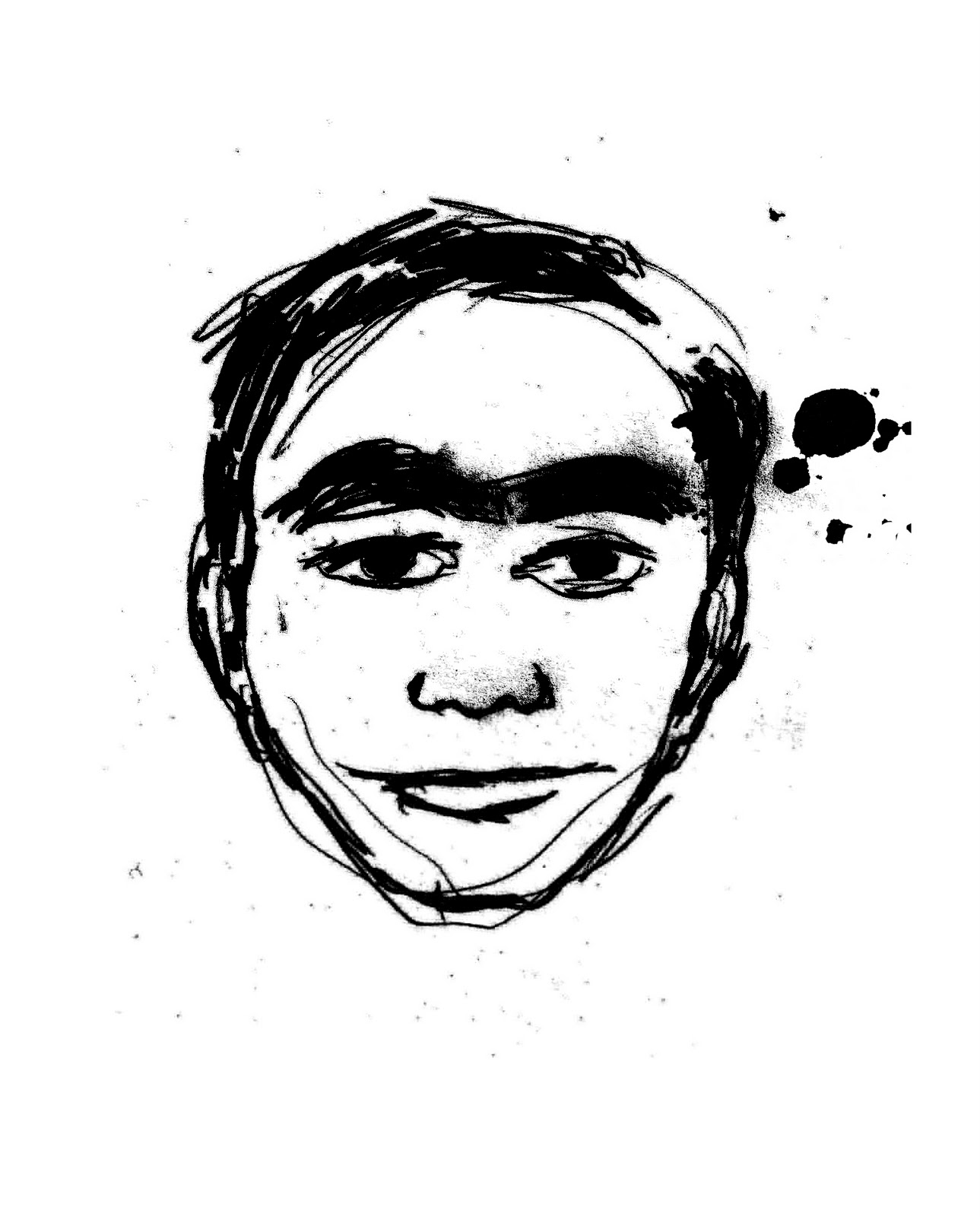
Ever Dream of This Man?


In January 2006 in New York, the patient of a well-known psychiatrist draws the face of a man that has been repeatedly appearing in her dreams. In more than one occasion that man has given her advice on her private life. The woman swears she has never met the man in her life.

That portrait lies forgotten on the psychiatrist’s desk for a few days until one day another patient recognizes that face and says that the man has often visited him in his dreams. He also claims he has never seen that man in his waking life.

The psychiatrist decides to send the portrait to some of his colleagues that have patients with recurrent dreams. Within a few months, four patients recognize the man as a frequent presence in their own dreams. All the patients refer to him as THIS MAN.

From January 2006 until today, at least 2000 people have claimed they have seen this man in their dreams, in many cities all over the world: Los Angeles, Berlin, Sao Paulo, Tehran, Beijing, Rome, Barcelona, Stockholm, Paris, New Dehli, Moscow etc.

At the moment there is no ascertained relation or common trait among the people that have dreamed of seeing this man. Moreover, no living man has ever been recognized as resembling the man of the portrait by the people who have seen this man in their dreams.


THEORIES

Several theories have been developed to explain the mysteriously recurring presence of this man in the dreams of different people who are not related in any way. The following theories are the ones that elicit the greatest interest among the dreamers themselves.

ARCHETYPE THEORY
According to Jung's psychoanalytic theory, this man is an archetypal image belonging to the collective unconscious that can surface in times of hardship (emotional development, dramatic changes in our lives, stressful circumstances etc.) in particularly sensitive subjects.

RELIGIOUS THEORY
According to this theory this man is the image of the Creator, that is to say one of the forms in which God manifests himself today. This is the reason why his indications and the words he utters during the dreams should be decidedly followed by the dreamers.

DREAM SURFER THEORY
It is the most interesting theory and the one that has the greatest implications, but it has also the lowest scientific credibility. According to this theory this man is a real person, who can enter people's dreams by means of specific psychological skills. Some believe that in real life this man looks like the man in the dreams. Others think that the man in the dreams looks completely different from his real life counterpart. Some people seem to believe that behind this man there is a mental conditioning plan developed by a major corporation.

DREAM IMITATION THEORY
This is a scientific psycho-sociological theory which claims that this phenomenon has arisen casually and has progressively developed by imitation. Basically when people are exposed to this phenomenon they become so deeply impressed that they start seeing this man in their dreams.

DAYTIME RECOGNITION THEORY
This theory states that the apparitions of this man are purely casual. Normally we do not remember precisely the faces we see in our dreams. The image of this man would thus be an instrument which, in the subject's waking life, facilitates recognition of an undefined oneirical image.


Thursday, October 28, 2010

Time Traveler? Video Shows What Appears To Be A Woman Talking On Cell Phone In 1928


The internets has been buzzing in the last couple of days about video footage that appears to show a woman talking on a cellphone… in 1928.

The footage is from the premiere of Charlie Chaplin’s film "The Circus" and was spotted by Belfast filmmaker George Clarke.

It shows a woman walking by the camera, talking with her hand to her ear, seemingly holding something to it.

What do you think?


Saturday, July 24, 2010

Strange creature ripping apart cattle in a small village of Ecuador


The small community of “La Cuadra” (The block) has seen multiple cattle mutilated and torn apart by something powerful. The ghastly findings are out of the ordinary, even for local known predators. The residents concluded that what ever it is that has killed steer and cows, it’s powerful enough to rip them apart and leave huge, deep prints with large claws in the mud.

Arming themselves with machetes, guns and flashlights a search party was rounded up in order to capture the creature. Upon investigation the residents saw a ‘large black animal move through brushes”. Nearby they found some cattle remains. What are the residents of La Cuadra dealing with?

Talks from the residents point to a possible escaped cougar. Others say that this is just another attack by the infamous Chupacabra.

No photographs of the paw prints have been released, although photographs of the mutilated cattle speak for the shocking attacks. What is stalking the cattle in Ecuador? In order to inflict that kind of damage seen in the photographs, I would have to say that a large cat is on the lose, or a pack of canids are attacking the cattle.


Saturday, July 17, 2010

Woolly Mammoth Resurrection, "Jurassic Park" Planned


A team of Japanese genetic scientists aims to bring woolly mammoths back to life and create a Jurassic Park-style refuge for resurrected species. The effort has garnered new attention as a frozen mammoth is drawing crowds at the 2005 World Exposition in Aichi, Japan (see photo).

The team of scientists, which is not associated with the exhibit, wants to do more than just put a carcass on display. They aim to revive the Ice Age plant-eaters, 10,000 years after they went extinct.

Their plan: to retrieve sperm from a mammoth frozen in tundra, use it to impregnate an elephant, and then raise the offspring in a safari park in the Siberian wild.

"If we create a mammoth, we will know much more about these animals, their history, and why they went extinct," said Kazufumi Goto, head scientist at the Mammoth Creation Project. The venture is privately funded and includes researchers from various institutions in Japan.

Many mammoth experts scoff at the idea, calling it scientifically impossible and even morally irresponsible.

"DNA preserved in ancient tissues is fragmented into thousands of tiny pieces nowhere near sufficiently preserved to drive the development of a baby mammoth," said Adrian Lister, a paleontologist at University College London in England.

Furthermore, Lister added, "the natural habitat of the mammoth no longer exists. We would be creating an animal as a theme park attraction. Is this ethical?"


Ice Age Giants

Mammoths first appeared in Africa about four million years ago, then migrated north and dispersed widely across Europe and Asia.

At first a fairly generalized elephant species, mammoths evolved into several specialized species adapted to their environments. The hardy woolly mammoths, for instance, thrived in the cold of Ice Age Siberia.

In carvings and cave paintings, Ice Age humans immortalized the giant beasts, which stood about 11 feet (3.4 meters) tall at the shoulder and weighed about seven tons.

"It is hard to imagine that woolly mammoths browsed around the places where we live now, and our ancestors saw them, lived with them, and even hunted them," said Andrei Sher, a paleontologist and mammoth expert at the Severtsov Institute of Ecology and Evolution in Moscow, Russia.

At the end of the last ice age, about 10,000 years ago, woolly mammoths dwindled to extinction as warming weather diminished their food sources, most scientists believe.

There are believed to be ten million mammoths buried in permanently frozen soil in Siberia. Because of the sparse human population in the region, though, only about a hundred specimens have been discovered, including two dozen complete skeletons. Only a handful of complete carcasses have been found.


Viable DNA?

The scientists with the Mammoth Creation Project are hoping to find a mammoth that is sufficiently well preserved in the ice to enable them to extract sperm DNA from the frozen remains.

They will then inject the sperm DNA into a female elephant, the mammoth's modern-day counterpart. By repeating the procedure with offspring, scientists say, they could produce a creature that is 88 percent mammoth within 50 years.

"This is possible with modern technology we already have," said Akira Iritani, who is chairman of the genetic engineering department at Kinki University in Japan and a member of the Mammoth Creation Project.

In 1986 Iritani's lab successfully fertilized rabbit eggs artificially, employing a technique now used in humans. In 1990 his colleague Goto, the Mammoth Creation Project head scientist, pioneered a breeding plan to save a native Japanese cow species by injecting dead sperm cells into mature eggs.

The current challenge, however, is finding viable woolly mammoth DNA. The DNA in mammoth remains found to date has been unusable, damaged by time and climate changes.

"From a geologist's point of view, the preservation of viable sperm is very unlikely, and this is so far confirmed by the poor condition of cells in the mammoth carcasses," said Sher, the Russian paleontologist.

Current Siberian permafrost temperatures are 10 to 18 degrees Fahrenheit (minus 12 to 8 degrees Celsius), which may not be cold enough for DNA survival.

Sperm is not the only possible DNA source, and mammoth-elephant crossbreeding isn't the only potential way to resurrect the woolly mammoth.

An alternative method would be to clone a mammoth from DNA found in mammoth muscles or skin. To do this, however, scientists would need preserved cells with some unbroken strands of DNA.

"There is no evidence this exists, and even if it did, it is very unlikely to be preserved without significant errors having accumulated—probably leading to birth defects," said Lister, the London paleontologist.


Safari Park

The Japanese scientists, however, are not deterred.

Iritani is planning a summer expedition to Siberia to search for more carcasses.

His team has already picked out a home for living mammoths in northern Siberia. The preserve, dubbed Pleistocene Park, could feature not only mammoths, but also extinct species of deer, woolly rhinoceroses, and even saber-toothed cats, he said.

"This is an extension of my work for the past 20 years in trying to save endangered species," Iritani said.

Other scientists are less enthusiastic about the project.

"Even if the cloning experiment is successful, they are not reconstructing the past but rather creating a new mammoth-like creature," said Anatoly Lozhkin, an Ice Age expert at the Northeast Interdisciplinary Scientific Research Institute in Magadan, Russia.

"Scientists are always able to learn from every experiment, but I am not sure that cloning a mammoth will help us significantly move forward our understanding of the animal or the conditions under which it lived," Lozhkin said.


In May 2010 it was reported that a Canadian-led research team has successfully revived a long-dormant blood protein from the DNA of an extinct mammoth, solving the mystery of how the elephant's woolly cousin evolved to live in cold, northern ecosystems before dying out after the last Ice Age.

In the breakthrough experiment headed by University of Manitoba biologist Kevin Campbell, the scientists "resurrected" woolly mammoth hemoglobin to determine how adaptations in the blood protein helped the species survive in Arctic and sub-Arctic habitats so vastly different than the African environments roamed by its pachyderm relatives.

The Mysterious Flying Creatures of Texas


For centuries, many of the Native American tribes who live in the western half of the US have told stories of creatures known as thunderbirds. Big (and fierce) enough to feed on full-grown bison, with wings so powerful that they could produce thunderclaps, the birds hold a special place in tribal lore.

But could thunderbird legends be based on animals still living in remote parts of America?


In 1890, two Arizona cowboys claimed to have killed a gigantic, featherless bird. Photographs (which disappeared long ago) are said to have shown a strange creature with an alligator-like head and a wingspan longer than the length of a barn. Some believe that the bird's description matches that of the extinct Pteranodon (see above).


In the years since, sightings of similar flying “monsters” have been surprisingly common, particularly in South Texas. According to one terrified San Antonio eyewitness, an enormous, black creature with “stooped-up shoulders” flew over his car less than ten years ago. In 1976, three school teachers reported that their car had been similarly “buzzed.”

Yet another reputable witness claims he once saw two of the birds perched on a hillside. “These creatures were so huge they looked like the size of small planes,” he said. “All of the sudden one of them jumped off dropped off the top of the mountain, came down the front of the mountain and all the sudden these huge wings just spread out. I would say the wings were at least a 20-foot wingspan.”


'Alien Baby' Stumps Experts

IS this bizarre creature really an alien baby or just part of an elaborate hoax - and was it the cause of a mysterious revenge death?


Mexican TV revealed the almost unbelievable story - in 2007, a baby 'alien' was found alive by a farmer in Mexico.

He drowned it in a ditch out of fear, and now two years later scientists have finally been able to announce the results of their tests on this sinister-looking carcass.

At the end of last year the farmer, Marao Lopez, handed the corpse over to university scientists who carried out DNA tests and scans.

He claimed that it took him three attempts to drown the creature and he had to hold it underwater for hours.

Tests revealed a creature that is unknown to scientists - its skeleton has characteristics of a lizard, its teeth do not have any roots like humans and it can stay underwater for a long time.

But it also has some similar joints to humans.

Its brain was huge, particularly the rear section, leading scientists to the conclusion that the odd creature was very intelligent.

But it has seemingly left experts stumped.

And in a further mystery, Lopez has since mysteriously died.

According to American UFO expert Joshua P. Warren (32), the farmer burned to death in a parked car at the side of a road.

Apparently the flames apparently had a far higher temperature than in a normal fire.

Now there are rumours that the parents of the creature Lopez drowned were the ones who in turn killed him out of revenge.

There are frequent UFO sightings and reports of crop circles in the area where the creature was found. Perhaps it was left behind deliberately by aliens.

Mexican UFO expert Jaime Maussan (56) was the first to break the story. He claimed it was not a hoax. Farmers also told him that there was a second creature but it ran away when they approached.

Canadian Scientist Says He Can Create Dinosaurs From Chickens


Hans Larsson believes that by flipping certain genetic levers during a chicken embryo's development, he can reproduce the dinosaur anatom.

Hans Larsson, the Canada Research Chair in Macro Evolution at McGill University in Montreal, said he aims to develop dinosaur traits that disappeared millions of years ago in birds. Mr Larsson believes that by flipping certain genetic levers during a chicken embryo's development, he can reproduce the dinosaur anatomy, he told AFP in an interview.

Though still in its infancy, the research could eventually lead to hatching live prehistoric animals, but Mr Larsson said he has no immediate plans to create dinosaurs, for ethical and practical reasons - a dinosaur hatchery is "too large an enterprise."

"It's a demonstration of evolution," said Mr Larsson, who has studied bird evolution for the last 10 years. "If I can demonstrate clearly that the potential for dinosaur anatomical development exists in birds, then it again proves that birds are direct descendants of dinosaurs."

The research is funded by the Natural Sciences and Engineering Research Council of Canada, the Canada Research Chairs programme and National Geographic. The idea for the project, Mr Larsson said, came about during discussions with Jack Horner, the American paleontologist who served as technical advisor for the Jurassic Park films.

Mr Horner recently wrote a book entitled "How to build a dinosaur", in which he refers to the embryo experiment as part of a quest to create a "chickenosaurus."

Mr Larsson's team previously worked to uncover prehistoric animal remains, including eight unknown species of dinosaurs and five new types of crocodile in Niger. He also recently uncovered the remains of a new carnivorous dinosaur in Argentina.

Sunday, July 11, 2010

Chinese Airport shut down after UFO sightings


A Chinese airport was forced to shut down after this bizarre shape was seen streaking across the sky.

Freaked out locals in Zhejiang's provincial capital Hangzhou captured images and video of the object, which was described as a "comet-like fireball".

Xiaoshan airport officials spotted the UFO on their radar and chose to ground planes and divert incoming flights rather than risk a collision.

The shape disappeared off radar screens and officials have now launched an investigation into the sighting.


Some Chinese media reports said officials had indicated they knew what the craft was but could not disclose the details because of a "military connection".

An official statement is expected later today, the Daily Mail reports.

The airport was shut down for three to four hours during the incident and dozens of flights were diverted.

Friday, July 9, 2010

The real Moby Dick, an ancient cannibal


When a group of palaeontologists stumbled on a few large bones in a desert in Peru, they thought they were elephant tusks.

But it turned out the bones, some the size of a human shin bone, were teeth.

Further excavation revealed an almost complete three-metre-long skull and mandible, or lower jaw, that belonged to the mammoth mouth of a newly found but extinct species of sperm whale.

European researchers discovered the fossils, believed to be about 13 million years old, in the Pisco-Ica Desert in southern Peru while on an expedition in 2008.

The whale, nicknamed Moby Dick, was between 13 and 18 metres long and lived during the Miocene epoch - when sea levels could have been more than 50 metres higher than today.

The extinct species, dubbed Leviathan melvillei after Herman Melville, the author of Moby Dick, were raptorial feeders which caught their prey individually.

Their bite, from more than 30 teeth, some more than 10 centimetres wide, could be the biggest of any animal that has swum or roamed the planet.


With teeth so big, the whale probably wasn't a gentle giant of the ocean. It is quite possible their main source of food was other cetaceans, such as baleen whales, said the researchers, whose findings were published in the journal Nature.

"This sperm whale could firmly hold large prey with its interlocking teeth, inflict deep wounds and tear large pieces from the body of the victim," the researchers said.

Leviathan melvillei differ from modern-day sperm whales which, despite being one of the world's largest predators, feed mainly on squid. Modern sperm whales, which have small teeth in their lower jaw and are almost toothless in their upper jaw, use a suction technique to catch their dinner.

Scientists believe this ancient species of sperm whale died out as a result of the global cooling at the end of the Neogene period, less than 5 million years ago.

The fossil bones will be displayed in the Museo de Historia Natural in Lima.

Sunday, June 20, 2010

Giant Lizards of Australasia, the megalania prisca


The animals usually associated with the Australian continent are koalas, kangaroos, wombats, and crocodiles.

There used to be other animals, commonly referred to as megafauna, that roamed this continent before being wiped out by plague or man. These were nightmarish versions of the creatures that exist in Australia today, 10-foot tall kangaroos that fed on flesh rather than vegetation, and at least as recently as 3000 years ago, giant lizards that dwarfed the Komodo dragon.

These lizards were megalania prisca, a reptile reaching 30 feet in length and weighing at least 1,000 pounds or more. The Komodo dragon is roughly the size of a lion, but megalania was bigger than an average dairy cow. Extinct megalania is listed with the many casualties of the Ice Age. Or is it extinct? Creatures matching it's description has been sighted many times in the last century, and some sightings suggest that it lives also in New Guinea.

As recently as the late '70s there have been megalania sightings. In July 1979, Rex Gilroy was informed of footprints of the creature found in a recently plowed field. Across the field were 30 or so tracks from what looked like an enormous lizard. Rain had ruined most of the tracks but Gilroy was able to make a plaster cast of one that had been preserved. The footprint looked surprisingly like something that might have been made by a Megalania.

Also in 1979 a sighting of megalania arose, this time by the best possible witness. Herpetologist Frank Gordon, after conducting some field work in the Watagan Mountains in New South Wales, returned to his vehicle. After starting his engine he saw, what he at first thought was a log, scampering off. It ended up being a lizard of some 30 feet or more in length.


View Larger Map


Another incident includes a farmer who observed a gigantic lizard walking along one of his fields. It walked alongside a wire fence, so the farmer used a set of fence posts as a guide. His estimate of the beast was a length of twenty to twenty-five feet.

Megalania might not be constrained only to Australia--some sightings suggest it may live in New Guinea. A French priest in the 1960's was traveling up river with a native guide in order to reach his mission. During the trip he spotted a large lizard lying on a fallen tree in the sun. He told the native to stop, but being badly frightened, the native continued the journey. The priest returned to the spot the following morning and measured the tree. It was 40 feet long, yet the lizard almost matched it.

The wilds of the New Zealand islands may also have a monstrous secret lurking within them. There are 90 species of lizards currently known in New Zealand. Most are not of any impressionable size and yet from Captain James Cooks' first arrival in New Zealand, strange tales of large lizards have been passed down to fairly recent times. One of these lizards, the Kumi lizard, was apparently of impressive size.

When Cook arrived in Queen Charlotte Sound, in 1773, Tawaihura a local chief told Cook of an enormous lizard and gave him a drawing of the beast.
These giant lizards apparently lived in the trees and were greatly feared by the Maori.
There were also reports however, given to the early European settlers of a 5-6 ft lizard which the Maori also hunt and ate.

In 1875 a strange lizard like animal had been found in a flooded river in Hokianga.
The local Maori, out of fear of the animal, hacked it to pieces.
From the same area emerged the reported sighting of an 18 inch lizard, yellowish in colour which slid down into the water when discovered and was lost among the boulders of the Hokianga River.
1875 also saw Mr F.W Hutton present a paper “On a Supposed Rib of the Kumi”.
The paper spoke of the discovery of a ramus of the lower jaw of a pleurodont lizard from the Ernscleugh Cave in Central Otago.
The ramus seemed to give foundation to the at least sub-fossil existence of the Kumi lizard.
In the same cave a vertebral rib that also appeared to be from the same animal was found.

At the New Zealand Institute meeting of September 20th 1898 mention was made of a large, strange reptile allegedly seen near Gisborne.

Furthermore, in September of that same year, in Arowhana, a bushman working on a station was confronted by a 5 ft long gigantic lizard which advanced toward him.
The animal then subsequently fled into a Rata tree.
Lysnar, the owner of the station where the animal was sighted, and a party of men went in search of the animal.
They managed to photograph some footprints but did not come across the actual animal.


According to Aboriginal tradition, a 'horny-skinned goanna bunyip" is said to have existed in New South Wales and elsewhere across Australia under a variety of different names in the long-ago Dreamtime. It was described as being of enormous size and smelling "terrible". Their rock engravings and cave paintings across the continent clearly depict these and other reptilian monsters, but more on that matter later.

Aboriginal rock engravings depicting Megalania near Sydney and the central coast of New South Wales date as recently as 3,000 years-the age of some fossil fragments of the creatures found in various parts of eastern Australia, if not elsewhere.

We now turn to the north coastal and inland districts of New South Wales where Aboriginal people from most ancient times were well-acquainted with the giant monitors which they called "Mungoon Galli".

However, they appear to have confused these up-to-30-foot-long reptiles with another, larger beast, which they claimed to have reached the astounding length of 50 feet! That such a monstrous form could still survive out there in those wilds seems preposterous, but there are Aborigines who claim they do!

Even if extinct today, perhaps long ago in ice-age times, and earlier, such a species existed. And, if so, perhaps its fossil remains may yet turn up. These monsters were monitors in every detail. Aborigines say their legs were as much as six to seven feet tall when standing and in the walking position. They had a massive head at least four feet in length and a long thick neck, much like a monitor's, which reached a length of around 10 feet. The body reached about 20 feet in length, matched by a long thick tail of the same length.

"These monster-goannas once roamed the whole continent far back in the Dreamtime. Our people used to hunt these monsters in big parties, but hunters had to be careful; for if you were caught, these big fellas would pick you up in their mouths and eat you," said one old Taree Aborigine to a researcher back in the early 1950s.

Like their smaller 30-foot counterparts, they were said to overturn trees of reasonable size. Even today, when a large tree is heard to fall in the forest depths by day or night, Aborigines will say it is the work of a "Mungoon Galli".

Over the years some people have claimed to have found massive footprints of these creatures, but if so, no photographs or casts have been forthcoming. But there are genuine traditions of the monsters among the Aborigines, and until the terrain in which they are said to live can be explored properly, let us at least keep an open mind on the matter.

Aborigines say that strange noises heard near waterholes and certain forest areas near Taree and back of Kempsey are the sounds made by giant monitors, and they will not go anywhere near these places for fear of being caught and eaten by one of these reptiles.


There is a story from the Cessnock district about an incident said to have taken place in late December 1978. In a far paddock on his property, a farmer spotted a gigantic goanna-looking reptile ripping up a cow with its massive jaws and teeth.

The farmer (who did not wish his name to be known) was in a Jeep at the time. He raced off for the house and phoned up mates who, within the hour, descended on the property with their cattle dogs in pick-ups and Land-Rovers, armed with rifles. The location borders swamplands on the edge of thick-forested valleys and mountain country, and it was from there that the monster had obviously emerged.

By the time the search party arrived, all they could find was the half eaten cow, much blood, and many large indistinct tracks in the grassy ground. However, other squashed-about tracks and the marks of a massive tail could be seen on the swamp edge leading into the water. The dogs, as well as the men, refused to go any further.

Using nearby fence-posts to line up the creature at the time of his sighting, the farmer estimated that it was a good 35 feet (10.6metres) in length, and nine feet or so tall on all fours, counting the great body of the creature. However, few people believed him. Some argued that he must have butchered the cow himself and manufactured the tracks. If this was so, he certainly did a good job. But there are some strange things happening out in those mountains, and I for one am not laughing.

Over the years, inhabitants of the Cessnock district have often talked about enormous 30-foot reptiles that they maintain inhabit the dense forests that cover the full extent of the nearby rugged Watagan mountain range. And these monstrous beasts have been known to stray from their mountain homes onto properties on Cessnock's outskirts.

During the last week of December 1975, a Cessnock farmer, tending cattle on his property, caught sight of one of these reptiles moving in scrub nearby his barn. He said it was at least 30 feet in length, was of a mottled greyish colour and stood up to three feet off the ground on four powerfully built legs.

During the previous year of 1974, at least 10 detailed accounts of giant lizard activity reached reporters in Newcastle.


Mr Mike Blake does not think Megalania is extinct. During 1974 he was sitting on his farmhouse verandah one day with his utility van parked right in front of his house, situated near bushland outside Cessnock. Suddenly, from around the side of the farmhouse, one of these monstrous beasts walked around in front of his verandah between him and his parked utility.

Mike remained terrified and "glued to his chair", as he said later, while the enormous beast turned and looked at him before moving on leisurely across a nearby paddock toward scrub. Mike compared the lizard's length to his utility which was 18 feet in length. The lizard was at least 20 feet long and stood three feet from the ground.

For as long as residents of the Watagan Mountains have known of these giant lizards, so too have the inhabitants of the Port Macquarie-Wauchope district much further up the coast. Attacks upon cattle by giant goanna monsters are part of local folklore going back into last century.

On the hunt for the Blue Mountains big cat


Exotic feline or enduring phantom? Something big, something strange has been stalking the Blue Mountains for decades and it's back in the spotlight.


Paul Cauchi and his girlfriend Naomi were in a celebratory mood.

The couple had just signed the paperwork for their new home near Mudgee but that's not why they will remember May 28, 2010.

''We were driving through Yarrawonga and Naomi saw it first,'' explained Mr Cauchi.

'''Look,' she said, 'Can you see that? … It's … it's a panther!'

''And the moment I saw it, I swore out loud in disbelief - because that's exactly what it was.''

The couple had ''a perfect seven- or eight-second view'' of the creature standing in front of them, outside a goat farm.

''I'd heard the stories but never believed a word of it,'' said Mr Cauchi. ''I've seen how big feral bush cats grow, but this was no feral cat. There is no mistaking, this was a panther. Now I'm thinking, how has this remained in doubt for so long?''

NSW Minister for Primary Industries Steve Whan said he had been made aware of four other possible sighting of the ''panther'' this year.

"The state government takes all reports of alleged black cat sightings seriously,'' Mr Whan said.

Rumours have circulated for decades about a colony of panther-like cats roaming Sydney's western fringes and beyond: from Lithgow to Mudgee and the Hawkesbury to the Hunter Valley. While witnesses are routinely ridiculed, a new book published today presents a compelling argument that the creatures are more than simply folklore.

Mike Williams, co-author of Australian Big Cats - An Unnatural History of Panthers, said: ''I cannot tell you with any certainty what species of cat this is but there is no doubting it is out there. It's an extremely large feline that does not appear to be native to Australia.''

Chris Coffey, of Grose Vale, a hamlet at the foot of the Blue Mountains, saw it twice in the late 1980s. Since then, proving its existence has become an obsession. She has collected more than 450 statements from tourists, bushwalkers and locals including a NSW police officer, a Qantas pilot and a retired magistrate.

Mrs Coffey said: ''National Parks and Wildlife know it exists, because their own staff have seen it. The NSW government is aware it's here because their own reports conclude that. [But] due to negative media coverage, the current public perception is that we're all a bunch of idiots.''

The case took a twist in 2001 when a freedom-of-information request unearthed a series of confidential government documents that proved wildlife authorities were so concerned about the big cat and the danger to humans, they commissioned an ''expert'' to catch it.

The three-day hunt later failed, but ecologist Johannes J. Bauer warned: ''Difficult as it seems to accept, the most likely explanation is the presence of a large, feline predator. In this area, [it is] most likely a leopard, less likely a jaguar.''

In the years that followed, sightings continued to pour in. In 2003, Hawkesbury Council released a detailed map of sightings and livestock attacks, pinpointing Grose Vale, Grose Wold, Londonderry, Yarramundi, Bowen Mountain, Kurrajong, East Kurrajong, Colo, Agnes Banks, Windsor Downs, Ebenezer, and the Macdonald Valley.

The state government commissioned a second study in 2008. Fuelling cover-up claims, an FOI request later revealed two versions of the report, the latter heavily edited for public consumption - and stripped of its final conclusion which stated: ''It seems more likely than not on available evidence that such animals do exist in NSW.''

But sceptics continue to dismiss the creature as an urban myth. To date, there remains no solid proof, not a single photo that demonstrates that the exotic big cat is real.

Mrs Coffey remains convinced that evidence will emerge sooner rather than later - based on witness accounts, the creature is increasingly being spotted out in the open, and closer to humans.

Mr Williams, meanwhile, looks to the day when an opportunity arises to pinpoint the creature's origin. ''If these things were just leopards, we'd be losing bushwalkers left, right and centre - so that leaves us with something else. It has taken large livestock over the years and the fear is that one day a child could end up in the wrong place at the wrong time.''

According to Mrs Coffey's database, there have been several close calls. In August 2008, Brianna Lloyd, 11, and Burgundie Cartan, 12, were holidaying at Wisemans Ferry. Disobeying family instructions, the girls set off exploring a remote section of the park, then came face to face with a large black cat that sprang down from a tree in front of them.

"We heard all this crunching and then a big black thing dropped out of the tree with something [a dead duck] in its mouth, so we ran … it was hunched down like it was going to jump at us," Brianna said of the incident.

"It made a horrible growling noise. It was bigger than a labrador - it was a really big cat."

Sunday, June 6, 2010

New Montauk Monster sighting? Bizarre creature washes up in small Ontario town


Locals in a small Canadian town have been stumped by the appearance of a bizarre creature, which was dragged from a lake.
The animal, which has a long hairy body with bald skin on its head, feet and face, has prompted wild internet speculation that it is a more evolved version of the famous 'Montauk monster'.
The creature was discovered by two nurses in the town of Kitchenuhmaykoosib in Ontario, Canada, while out on a walk with their dog.

When the dog began sniffing in the lake, the two women started investigating, before the dog pulled the dead animal out.
After taking some photographs of the odd animal, the nurses left it alone. When locals decided to go back and retrieve the body, it has disappeared.


The photographs have now been posted on a local website, with an explanation which reads: 'This creature was first discovered by Sam the Dog, a local dog. 'It was discovered first week of May in the creek section of town, hikers noticed Sam sniffing something in the water and they approached to see in what the Sam had detected and they noticed the creature in the water face down.

'The dog jumped in the lake and pulled the creature to the rocks and dragged it out for the hikers to see and these are the photos they took. 'The creature's tail is like a rat's tail and it is a foot long.'
There has been much speculation about what kind of species the animal is. The body of the creature appears to look something like an otter, while its face - complete with long fang-like teeth, bears a striking resemblance to a boar-like animal. Even the local police chief Donny Morris is baffled, saying: 'What it is, I don't know. I'm just as curious as everyone else.'


The pictures of the animal have caused mass speculation online, from bloggers who are all stumped as to what the creature could be.
One internet blogger wrote: 'That certainly is a face only a mother can love. It looks like some sort of otter, weasel-type thing.'
While another added: 'Some kind of mustelid - I thought otter first.
'Being in the water and bashed around has made the fur on the face and tail come off so clean like that.'
Many people have suggested the animal could be a new 'Montauk monster' - due to the similarities between these photographs and those of a different creature which washed up in Montauk, New York, in 2008.

The animal, which quickly earned the nickname the 'Montauk monster', thanks to the beach's location to a Long Island government animal testing facility, has never been officially identified - although the general consensus is that it was some kind of racoon.
However, other bloggers have speculated that the new creature discovered is a type of chupacabra, or 'goatsucker'.

The chupacabra is rumoured to inhabit parts of the U.S. , with many several hundred eyewitness accounts over the past few years.
But despite these sightings, the majority of biologists and wildlife experts believe the chupacabra is a contemporary legend.